
🌹Mary Magdalene, the Alabaster Jar🕯️Reclaiming the Sacred Feminine and the Truth of Christ’s Beloved
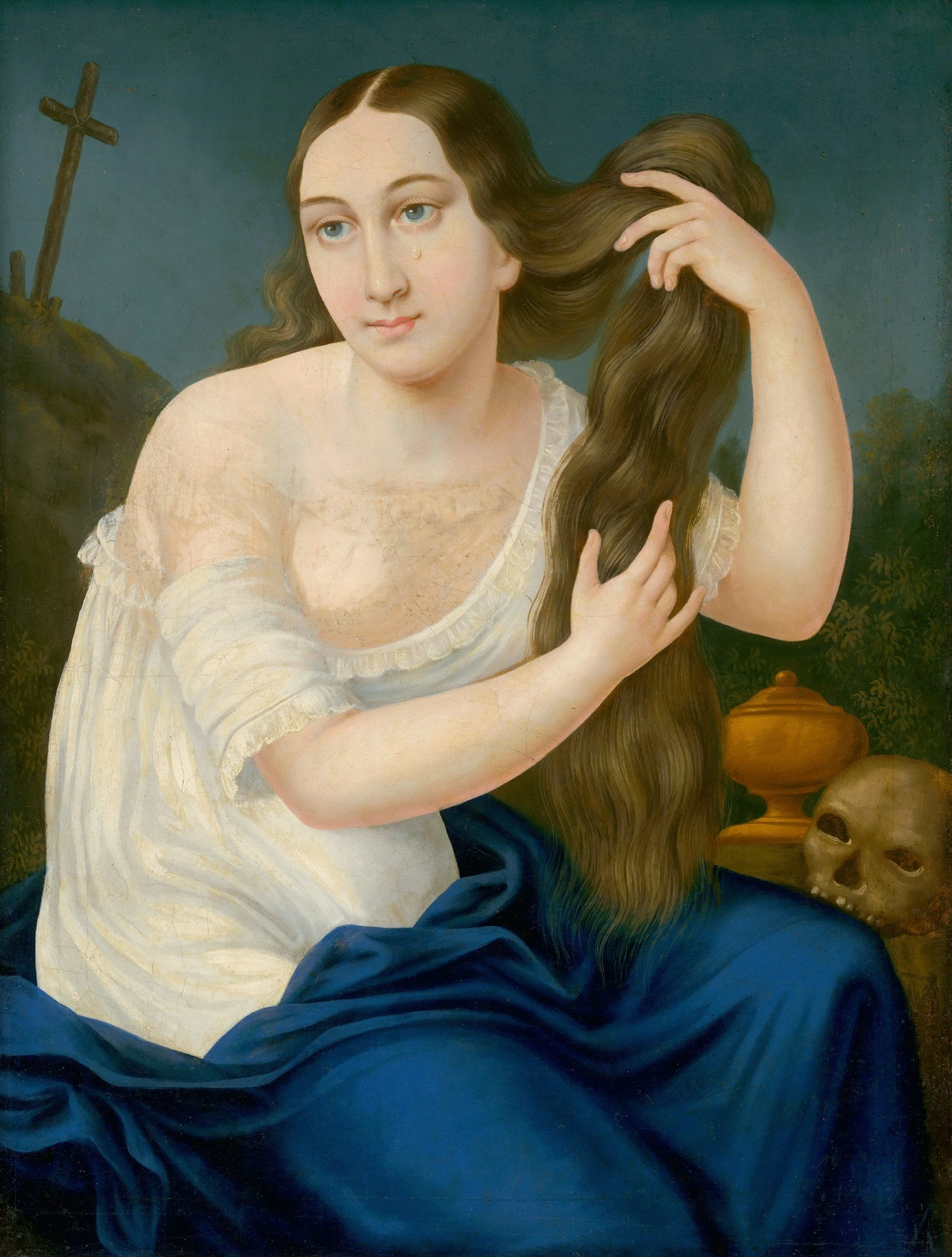
Mary Magdalene and the Sacred Feminine: Unveiling the Woman Who Knew Christ
For centuries, Mary Magdalene has stood at the edge of Christian memory—painted by Church doctrine as a penitent prostitute yet whispered of by mystics and seekers as something far more profound: the beloved of Christ, the embodiment of the sacred feminine, perhaps even the mother of his child. Her image flickers like a candle in the shadowed corridors of history—never fully extinguished, though long obscured.
What if she was never the fallen woman we were told she was? What if she was Christ’s equal in spirit—his wife, his co-teacher, the true apostle to the apostles? What if the story of Christianity, as we’ve inherited it, is only half told?
Reclaiming Mary from the Ashes of Doctrine
Mary Magdalene appears in the canonical gospels as one of the few figures who remain loyal to Jesus to the end and beyond. While male disciples flee in fear, it is Mary who stands at the cross, who prepares his body for burial, and who first sees the risen Christ. In John’s gospel, her moment with the resurrected Jesus is achingly intimate: she weeps beside the tomb, and when he speaks her name—Mary—she recognizes him, crying out Rabboni, teacher.
But despite the spiritual power of this encounter, the Church Fathers chose a different story for her. In 591 AD, Pope Gregory I conflated Mary Magdalene with the anonymous sinful woman who anointed Jesus’ feet in Luke’s gospel. Without scriptural support, he declared that Mary had been a prostitute, possessed by seven demons representing the seven deadly sins. With this, her legacy was sealed for over a millennium, not as apostle, not as beloved, but as redeemed harlot.
This recasting served a purpose. The early Church was shaping its structure: hierarchical, patriarchal, and controlled by male clergy. A woman in a position of spiritual authority, especially one favored by Christ, was a threat to this foundation. And so, Mary Magdalene became a cautionary tale rather than a cornerstone.
Her Origins: Royal Lineage, Siblings, and the Meaning of “The Tower”
Mary Magdalene is believed to have come from the town of Magdala or Magdalum, a fishing village along the western shore of the Sea of Galilee. The name "Magdalene" is not a surname, but rather a title meaning "of Magdala." Yet in Aramaic, the word “Magdal” (from the Hebrew word Migdal) also translates to “tower” or “greatness.” For this reason, Mary has long been known not only by her place of origin, but symbolically as “Mary the Tower.”
This title likely signifies more than geography; it reflects her spiritual presence. As Jesus renamed disciples to express their deeper essence—Simon became Peter, the Rock, James and John were the Sons of Thunder. In that tradition, calling Mary “the Tower” may have spoken to her strength, clarity of vision, and role as a protector and carrier of hidden wisdom. She was the one who remained when others fled, the one who saw when others doubted. Her title hints at her authority, her spiritual vigilance, and the unwavering insight that made her a cornerstone of Christ’s inner circle.
According to medieval tradition especially the writings of 13th-century Dominican monk Jacobus de Voragine, Mary was born into a noble, wealthy family of royal descent. She was also the sister of Martha and Lazarus; both intimately connected to Jesus. Their home, often described as a place of refuge and spiritual gathering, suggests that this family played a central role in Jesus’ life and ministry. It was a house of friendship, depth, and presence.
After the crucifixion, legends tell of Mary, Martha, and Lazarus fleeing persecution, sailed across the Mediterranean, eventually arriving in southern France. There, Mary is said to have lived in a cave at Sainte-Baume in Provence, dedicating her final years to prayer and spiritual retreat. Sustained by the angels, she became a mystic in solitude. Her relics were later brought to Vézelay, where they drew pilgrims from across Europe. Even in 1641, when a Parisian scholar published a Dissertation on the False Arrival in Provence of Lazarus, Maximinus, Magdalene and Martha to challenge the tradition, devotion to her never waned. Her legend had outgrown the need for validation. She had become more than a biblical figure, she had become a sacred presence, a tower of remembrance.
Who Was the Real Mary?
To truly understand her, we must look beyond the canon to the Gnostic Gospel of Mary Magdalene, Gospel of Philip, and Gospel of Thomas. In these texts, Mary is not only prominent, but she is also illuminated. She comforts the apostles after Jesus’ death, shares his hidden teachings, and reveals a deeper level of understanding that even Peter resents. In the Gospel of Philip, she is described as Jesus’ koinōnos, a partner, companion, or spouse. Jesus is said to have loved her more than any other disciple, kissing her often, a symbol of spiritual transmission, intimacy, and trust.
The tensions between Peter and Mary in these gospels speak volumes. When Peter questions her authority, Levi (also known as Matthew in some traditions) steps in and says:
“Peter, you have always been hot-tempered. Now I see you contending against the woman like the adversaries. If the Savior made her worthy, who are you to reject her? Surely the Savior knows her well. That is why he loved her more than us.”
Was She, His Wife?
It’s a possibility many now dare to explore. While no gospel explicitly states Jesus and Mary were married, the closeness of their relationship, especially in the Gnostic texts, challenges the traditional narrative. To consider Mary not only as Jesus' closest confidante, but his beloved, his partner in both flesh and spirit, is to rethink the foundations of Christian theology.
Some even speculate that Mary bore Christ’s child. Medieval legends, particularly in southern France, tell of her arrival with a young daughter or son. These stories, once consigned to folklore, suggest that a lineage may have continued, not merely biologically, but spiritually. A living bloodline of Christ would threaten the Church’s claim to divine authority but to mystics, it might represent the transmission of sacred wisdom through generations.
The Sacred Feminine Buried
Mary Magdalene’s erasure mirrors the suppression of the feminine divine itself. As Christianity absorbed the spiritual terrain of the ancient world, it pushed aside female archetypes of wisdom, sexuality, and sovereignty. The Virgin Mary was elevated but only as passive mother, not as a teacher or equal. Mary Magdalene, earthy, passionate, spiritually potent had to be diminished to preserve the new orthodoxy.
And yet she endured.
Mary Magdalene & the Dragon Energy
In many esoteric and Gnostic traditions, Mary Magdalene is associated with dragon energy — a primordial current of wisdom, sovereignty, and embodied power. The “dragon” in mystical symbolism does not refer to a literal creature but to the serpentine life force that rises through the body, awakening spiritual sight and deep intuition. This same current appears in cultures worldwide: the kundalini serpent, the Celtic dragon lines, and the alchemical red and white dragons representing the balance of forces within.
Mary Magdalene, as the embodiment of the Divine Feminine in her fully awakened form, carries this energy as a teacher, priestess, and initiator. Dragon energy in her lineage speaks to:
Inner fire — the courage to transform one’s life from the inside out
Truth-telling — the fierce clarity to speak and live authentically
Sacred sovereignty — standing in one’s own spiritual authority
Healing power — the ability to move energy, release old patterns, and awaken others
Some modern Magdalene traditions describe her as a guardian of the Rose and the Dragon, two archetypal forces that balance softness with strength. The rose opens the heart; the dragon empowers the will. Together they form a pathway of embodied love that is fierce, wise, and active in the world.
In this sense, “Magdalene dragon energy” is not destructive but transformational. It burns away what no longer serves, strengthens your spiritual backbone, and reconnects you to the deep feminine mysteries that Mary carried through her teachings.
From Black Madonna statues to the alchemical “Rose” of the Grail legends, Mary Magdalene’s image continues to rise in esoteric and mystical traditions. She is no longer the harlot of confessionals, but the High Priestess of memory, one who kept the teachings alive when the world turned its back.
Why Her Story Matters Now
Mary Magdalene matters because her story, like so many women’s stories, was twisted to serve power. But she also matters because of what she represents: wholeness. She embodies the balance of masculine and feminine, of action and intuition, of presence and proclamation.
In a time when spirituality is seeking to rebalance itself, her voice is rising again. To reclaim her is not to revise history for the sake of novelty, but to return to a deeper truth that was always there, waiting beneath the rubble of dogma.
Jesus, it seems, did not fear feminine wisdom. He walked beside it. He entrusted it with the greatest message in all of Christianity: that death is not the end, and love is stronger than the grave.
And he chose Mary, the Tower—to carry that light into the world.
In a world hungry for sacred balance, she returns to us now, not to be worshipped, but to remind us of the wholeness we lost when we silenced the feminine.
She is not forgotten.
She is not erased.
She is the Tower.
She is the Jar.
She is the one who knew.
